
Transcript
The Dr. Kristin Lyerly Show · Wed Nov 25, 2026
We just need to keep talking about it and we need to de-stigmatize that word abortion because it is not always what people have been indoctrinated to think it is and we need some political will that is not just one way or the other.
We need politicians that are willing to listen because I think the average person in our community fully supports
the need for access to maternal health care and the need for government to stay out of it.

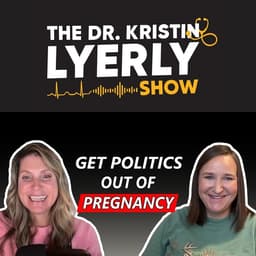
Hello and welcome to the Dr. Kristen Lyrely show.
I'm Dr. Kristen Lyrely and I am here with one of the most courageous, wonderful people I have ever met.
Her name is Megan Kling.
She lives in Western Wisconsin and she
is a mom.
She is a Wisconsinite to the core and she is an advocate for abortion rights because she was put in a situation where she had a pregnancy that was challenging and she learned a lot throughout that process.
So we're going to talk about that.
We're going to talk about a movie we did together and we're going to talk about where we go from here.
But for now, hello, Megan.
Welcome.
Thank you for having me, Kristen.
I am so excited for you.
Today is Sunday that we're taping and this is gonna air the day before Thanksgiving and you have so much to be thankful for.
We'll get to that at the very end.
But today you are the front page story in the Milwaukee Journal Sentinel.
Yeah, I am.
Yeah.
And you've had this ongoing story since your family was first struck by tragedy that you never anticipated.
So why don't we just start with your story?
Yeah.
So Sam and I, my husband had always wanted three kids.
And we had two uncomplicated pregnancies.
We have two healthy little girls who are now four and seven.
But in 2023, when we were expecting our third child, everything was smooth up until the anatomy scan, which occurred at 21 weeks.
And we had received devastating news that the baby I was carrying had a non-viable diagnosis that he had developed without kidneys.
And there was really no option for me in the state of Wisconsin
other than to continue to carry the baby that would either die in utero or shortly after giving birth, no matter
what.
A baby without kidneys, to be very clear, cannot survive.
You have to have kidneys.
Kidneys make the fluid around the baby.
The fluid is necessary for lung development.
This is something that you don't expect.
You think, like you said, you think your pregnancy is going to be fine and healthy and then this.
So what went through your head as you were trying to figure out what your options were and where you could go from here?
So I very instinctively knew that carrying a non-viable pregnancy
was not in my best interest physically or mentally as a working mom.
And my husband and I aligned on that, which was very helpful.
And I was aware that with where abortion laws were at in the state of Wisconsin that there was likely no option for me.
So we chose to be induced.
And in order to do that, I needed to find a hospital.
And so we were referred to Minnesota and we went to Rochester to be induced at 23 weeks and deliver our only son.
I can't imagine how heartbreaking all of this must have been.
Did you feel pressured as you were figuring out the diagnosis and understanding that an abortion, which is technically what this is, was the best alternative for you with this pregnancy?
So
I never felt pressured.
Every doctor I saw locally and when I was referred to maternal fetal medicine Every doctor I saw was very cautious and very careful not to recommend to me what to do next They answered all of my questions that I asked Sam and I just made sure we were informed and fully understood the diagnosis and
I was the one that brought up to each of my doctors that I would prefer to be induced, that I do not want to carry a non-viable pregnancy.
So that was never my experience to feel influenced whatsoever by anyone on my medical care team.
Did you feel
at any point because there's a number and it's an arbitrary number that sets a limit on when you can get an abortion in many states.
And in Wisconsin, that wasn't an option for you, which is why you had to go to Minnesota, but Minnesota also has a number.
Yeah.
Did you feel that there was a time pressure there for you, that you had to make a decision quickly because you were running against the clock?
Yeah, absolutely.
So I was already 21 weeks when we got
the initial diagnosis that something was wrong.
I was 22 weeks by the time I got into maternal fetal medicine and had the diagnosis confirmed without a doubt.
But it was ultimately 10 days before my first anatomy scan until I could get in to the Minnesota hospital.
So when I ultimately
delivered our son at 23 weeks.
It was 23 weeks in two days.
So another five days later, I would not have had the option at Rochester, Minnesota.
I can't even imagine what that must have felt like, that whirlwind of the diagnosis and all of the information and having to set everything up and get the appointments and all of that.
And then also the additional layer of knowing that
This was no longer what society considers pregnancy care, but now you had entered this whole other realm of the abortion world.
What was that like for you?
So I think that hit me the most, not only knowing that we had to go out of state, but when I was talking to the nurse at Rochester to schedule
our induction and ultimately another opinion when she told me I should look into my insurance company to make sure that my insurance coverage would pay for my induction in Minnesota because she said it's not uncommon for insurance policies to not cover abortion care and if that were the case and if we couldn't
afford out-of-pocket care at a hospital then ultimately she recommended going to Planned Parenthood in the cities which further angered me because you know with a non-viable diagnosis it didn't seem like a choice at all like no matter what choice I made our baby was gonna die and so I want to do at least do it on my terms
And to think that another woman in my shoes with a different insurance coverage wouldn't be able to even do that is just really sad to me.
Yeah, it's terrible.
And having to go to Planned Parenthood may offer excellent care to be very clear and necessary care.
But ultimately, you need the care that you need.
You know, you need to be able to make a decision about how to proceed with your pregnancy, especially in a situation like this where this is a desired pregnancy that is not turning out the way that you want it to turn out.
And it's heartbreaking.
But then to be confronted with the potential for extra cost and not having options, that must have been crushing for you and Sam.
Yeah, it was.
it all just compounded on top of those traumatic moments we were already going through as parents.
So for you this was your physical reality but for Sam it's an entirely different thing because he's you know he's your husband and he's the father of this child and he's kind of watching it and understanding it from a very different perspective.
How and I'm sure you talked about this.
And I know that he talked about this in the movie that we were in together, which we will talk about.
But how did Sam deal with this?
And how did the complexities that you've already talked about here factor into his ability to cope with what was going on with you?
Yeah, I don't know.
My husband is a very.
I would say strong man.
So as with many situations, he was very strong for me in those moments.
And we were just very matter of fact of what the next steps were.
Neither of us realized, like I think many individuals in Wisconsin that abortion bans would touch us.
that abortion restrictions would touch us.
And so we were confronted with this reality of this is a wanted pregnancy that we encountered devastating news with.
And now we are restricted in the care that we need for our situation.
And it just really blew the door wide open to better understanding that government shouldn't have any same pregnancy, that pregnancy is simply too complex.
to legislate, period.
I think one of the most compelling things about your story, Megan, is that
You are just so fundamentally a regular person in Wisconsin.
I mean just looking at your visual right now, it's the first weekend opening season for dear gun season and you've got all of your egg stuff behind you.
You live in rural western Wisconsin.
You are salt of the earth and this happened to you.
in an environment that is maybe not very supportive of abortion care, but is likely very centered in family values.
How does that tension play out in your life?
It's been a journey.
The reason that I shared my story and the reason I continue to share my story is to show that you cannot take abortion care out of maternal health care.
And so any legislation, any restrictions, any politics around abortion care can directly impact anyone who can become pregnant.
And I actually experienced that with two non-viable pregnancies.
And so with us being very regular people, Sam grew up on a dairy farm.
He owns a blue collar business.
I work in agriculture.
We are regular people.
We got married or growing our family.
We're sharing because we hope that a lot of people can just simply relate to us.
and better understand why politics should stay out of
this.
Yeah.
So after you had been through all of the physical stuff, what was it that made you decide that you needed to share your story?
Many people deal with situations like this, but it's so deeply personal that it's something that you don't often talk about, but you're different.
Yeah, I was really angry and When I am angry or upset about something I have a hard time Not taking action to change it I can't just sit on it and so First I saw Kate Cox as her story it was shared on national news in about a month after our termination and
From there, I started writing some of the state politicians that represent me, who were and still are all Republican, and I got no response.
And then that further angered me.
And so I just started networking, and I got connected with Jess, a journalist who specializes in health care at the Mocky Journal Sentinel.
And I was lucky enough that I found her to trust her to share our story very authentically for the first time back in March of 2024.
And so she just concluded her third edition on us following our story.
Jessica Venegrin is an excellent reporter with a long history of doing not just reproductive rights reporting, but healthcare reporting in general.
So incredibly lucky.
And you're right.
I mean, she earns your trust.
And then she's able to help you tell a story that otherwise may not have been shared in a sensitive and gentle way.
And then once your story was out,
people almost couldn't believe it because it was so unusual for someone like you in rural Wisconsin to talk about something so hard yet so common.
What happened after that?
Oh, I got a lot more opportunities to share my story.
I was even featured in a New York Times article with some other women who terminated for medical reasons across the US.
I was contacted by state and national politicians.
And I was just very cautious all along on who I would trust to share my story with.
And Jess at the Milwaukee Journal of Sentinel kind of became my media mom.
She was my sounding board where I could reach out to her and say, Jess.
this journalist or this person reached out to see if I'd share my story.
Can I trust them?
Like, do you think they would, you know, do an authentic job or not?
And I was just really thankful to have her guidance really ever since I trusted her with my story.
The Biden-Harris campaign had reached out.
I did turn them down.
The politics piece of it is really hard because
I want to be able to reach the everyday person with my story.
I want anyone regardless of their political affiliation to relate to our story.
And I knew that if I started using my name and my story to support Biden Harris at that time, that I would turn the ears off to others who don't align with me.
some of their politics.
And so I tried to just be very cautious of that because I just want to reach the everyday person and politics are so hostile right now.
It's really disappointing and this shouldn't be political in
my experience.
In everybody's experience it should not be political this is health care and everybody needs health care and as a physician like you and I are having this conversation as a doctor and a patient and thank God I mean honestly Megan that you have been able to speak out and that you found the resources to be able to do it safely.
But thinking about all of the other people out there who have been through something like this and the number of people who have come to me and said, I'm pro life, but, or I don't believe in this, but I'm in this situation.
And it is, it's politics that prevents people from feeling like they can.
step up and talk about their story and seek the care that they need and not feel ashamed for doing it.
And you have given so many people a voice and the courage to get the care that they need.
We all owe you a giant debt of gratitude.
Oh, thank you, Kristen.
The first time I
heard about you.
I heard whisperings because of the reporting, but the first time I heard about you is when Christy Turlington Burns and her organization, Every Mother Counts, was visiting me because they were putting together a documentary called Perilous Passage Birth in America, and we spent some time together here in Green Bay, and then they were taking off to visit this extraordinary woman in Taylor.
And they were so worried about you because you had been through all of this and told your story and they were excited to talk to you, but also you were pregnant again.
And it was right at that time when you were going to be having your anatomy scan, that 20 week scan.
And this was when the previous pregnancy really took a turn for you.
Tell us what happened around that time.
So in 2024, we were pregnant again with our son without developing kidney is that was not genetic.
So I wasn't real scared to try again.
In fact, I was pretty determined to complete our family.
But I was scared after what we went through when you are pregnant following a traumatic loss like that.
You don't shake that the entire pregnancy.
So I was scared, but I knew that I wasn't going to complete my family without going through that.
And so I believe I was around 16 weeks pregnant when Christy Turlington came and interviewed me initially.
And then they followed me through the 20 week ultrasound.
We were referred to maternal fetal medicine again because there was only one kidney, but I remember that appointment being so short.
At maternal fetal medicine, the doctor came in and he's like, yeah, there's only one kidney, but kids can live long, healthy lives on one kidney.
Like there's nothing to worry about.
Like you're healthy, the rest of your baby is healthy.
You can go home.
Like there's nothing high risk about your pregnancy.
And we were just incredibly relieved in those moments to hear those words.
But then what happened?
So that was at 19, 20-ish weeks.
And about three years later, it was actually this weekend, two years ago exactly, that I was sitting in a deer stand all by myself.
And, you know, as a mom of two young kids, I don't get many moments to myself that are quiet.
And I realized that I hadn't been feeling my baby move.
And I couldn't remember the last time that I had felt my baby kick.
But my therapist had told me that getting past 23 weeks was going to be the hardest because that was the gestation that I had lost my prior pregnancy at.
And so being a glass half full type of person, I just assured myself it's got to be all in your head.
And again, like everything has got to be fine.
But just to know for sure, I personally messaged my OB nurse that night and said, hey, can I come in tomorrow morning just to be verified that everything sounds great.
And you can check the heartbeat.
And she said, yeah.
I didn't even tell my husband that I was going in because I was so sure that everything was in my head and I did not want to order him but when I got there I They couldn't find the heartbeat and they did an ultrasound and confirmed that our baby had passed and the ultrasound did not give any rhyme or reason to why and so Sam had met me at the doctor by that point and we
were for a second time talking about being induced at 23 weeks because my body had not started any signs of labor yet.
My body was not recognizing that the baby had passed.
So I needed to be induced to protect myself from infection.
So here you are at 23 weeks again, but these circumstances were
entirely different because although that first loss, there were no kidneys and this was a non-viable pregnancy, that was an abortion and you had to travel to Minnesota and all of that.
What happened with this pregnancy?
What were your options here?
So this pregnancy I could be induced locally with my doctor that I trust.
But when I started asking questions about
what that process would look like, and if it would be the same type of care that I had received in Minnesota to be induced at 23 weeks, her answer was yes, but without myphipristone.
And as an informed patient, I knew why I was given myphipristone in Minnesota because that
included in my standard of care was going to decrease chances of further complication or retained tissue or hemorrhage after I delivered baby.
I asked why I wasn't being given that medication and her answer was simply I don't have access to it and she offered to call some of the other larger hospitals nearby to see if they had it and that answer was no.
So I was in
I was induced the following day and luckily I had no complications, but I came to realize that because that drug is associated with abortion, I was restricted from access to it even to protect my health when delivering a stillborn.
So once again, you are in a situation where you are suffering.
through a pregnancy loss, a highly desired pregnancy loss, the second one in a row.
And you're again caught in the abortion debate because of Miphaprisodon and because of politics.
Yeah.
So I was angry again.
Yeah.
After that, you
Your voice got even louder.
And you continue to do this advocacy work.
Actually, you had reached out to me like two weeks ago and said, what more can I do?
My state representatives are still not listening to me.
They don't return my calls.
I need them to understand what's happening here.
And you and I are going to continue to work together here in Wisconsin now that we have a more favorable climate.
And we can hopefully get some really good stuff done for women's health here.
But what do you think, as you are looking to the future, where do you think your voice can be as impactful as possible?
I really don't know, because if you would have asked me two years ago, that
If I thought I would make a HBO documentary or beyond the front page of the New York Times, like I would have never believed anyone to tell me that.
So I don't know.
All I know is maternal health has become a significant passion of mine.
And I have three daughters now who might be pregnant someday.
And I just feel like I need to continue to share my story wherever it can be effective to help create a safer environment for anyone to be pregnant.
And you said I have three daughters right now because after the second pregnancy was so challenging, you had a rainbow baby.
Yeah, I Would not give up and we were able to finally get a very healthy pregnancy and I got the birth that I had hoped for and we welcomed a third healthy daughter in April of this year
Now you have everything to fight for you always did but even more so
yeah
Let's talk a little bit about what it was like to be in this documentary because I agree with you.
It's wild.
I think when we were first contacted about it, it just seemed like the right thing to do because we were going to be advancing maternal health and we were going to be telling our stories and whatever we can do to get the word out there and help more people understand how complicated pregnancy can be and how we need compassionate care and options and support, not political interference.
to know that when we got the call that this was going to be an HBO Max movie and that anybody right now could go to HBO and turn it on and watch Perilous Passage with your story and my story and Allie Phillips who was just elected to the Tennessee state legislature that her whole story started with a pregnancy much like yours and she was angry and she told her story and she kept fighting and now she's a representative in Tennessee.
There are so many incredible and important stories that are relatable for regular people in the US.
But to know that you are part of this, Megan, you're famous, you're a movie star.
Oh, I wouldn't say that, but yeah, it was crazy.
I still remember when they called me and asked me questions about my story and I shared it with them.
you know my response was like well let me know you know if you're interested and like are you are you sure but I like I couldn't believe that my story you know was going to be a part of that project you know I just feel like a regular person who has shared you know a very I don't know probably common story uh that
I just could not believe that they wanted to share it, including in the film.
But it is a common story and Christy Tarlington Burns situation was a common situation this entire thing grew out of she had a delivery that was attended by a Certified trained person and she bled after the delivery which happens all the time postpartum hemorrhages are very very common and She didn't realize the kind of danger that she was in and she ended up going back to school and getting masters in public health and turning her own personal experience into advocates
And then finding people like you and me so that to help us turn our stories into that kind of advocacy so that we can improve birth outcomes here in the United States where our maternal death rate here in this country is abysmal for the most We spend more money in this country on health care than any other country on earth by far But we have the worst maternal outcomes of any developed country and it doesn't make any sense.
So there's a need for people
like us to tell our stories and for us to be able to break through the politics so that we can actually get back to health care.
Yeah, it just doesn't seem like it's being prioritized the way it should.
Yeah.
So a lot of people would assume that situations like what you went through, which was a lot of different things that happened in a lot of different dimensions, people would assume that the law is pretty straightforward.
There's a limit and this is what you do.
But that wasn't at all your experience.
What would you say to somebody who says, what's the problem?
The law is very clear.
Well, for one, I would say the law is not clear.
There is confusion on how you interpret the Wisconsin law right now.
Is it 20 weeks or is it 22 weeks?
Because I believe the way it's written in legislation is 20 weeks post-fertilization.
which is not the language that anyone uses during pregnancy.
So that would be technically 22 weeks, but everyone in the medical system operates, interprets it by 20 because they're not going to push it.
I would also share that when Sam and I went after our second significant loss to preconception counseling at a larger hospital in Wisconsin,
And we were talking through what another pregnancy would look like.
They had no rhyme or reason to why we experienced our complications.
So they were only focusing on what extra monitoring would look like with a future pregnancy.
And I challenged that maternal fetal medicine doctor a little bit.
And I said, OK, so let's say we do all this extra monitoring.
and I make an hour drive to this larger hospital more regularly.
And let's say by 13 weeks, we find out that my pregnancy is non-viable again.
I looked her in the eye and said, can you help me?
And her response was, well, we would typically refer you to Madison or Minnesota.
And so even though the law says 20 weeks,
Because there is so much politics around abortion, hospitals want to stay far away from anything that's associated with it, if they can't.
And so anyone, even with a legal, within the legal limit of abortion, for a medical reason, is still often turned away from their local hospital and almost shamed away, I feel, to somewhere that they're not familiar with.
to a clinic.
And you talked about how you might have to drive an hour to a hospital for monitoring, which brings up a whole other issue, which is rural health care access, because we don't have
access in so many parts of the state and the country, really.
But in Wisconsin, we've lost over half of our rural obstetrical units over the last 20 years.
We are losing providers.
We can't keep up.
And people are having to drive further.
And when you add that to the political piece and the
polarizing language that people use.
The word abortion means it's just such a harsh word, but it also just means a pregnancy loss, you know, a miscarriage is a spontaneous abortion.
When you add all of that stuff together, how do we break through in a community like Taylor, Wisconsin?
to get people to start having these conversations about how this environment is affecting our ability to get care, our families, our communities as a whole.
Because if we can't have these conversations, we're not going to be able to solve these problems and get access for each other for the future.
I think we just need to keep talking about it.
And we need to de-stigmatize that word abortion.
because it is not always what people have been indoctrinated to think it is.
And we need some political will that is not just one way or the other.
We need politicians that are willing to listen because I think the average person in our community fully supports the need for access to maternal health care.
and the need for government to stay out of it, and the need to have access.
People support that.
But how do you get politicians to also get behind that?
And that red versus blue is a little too strong.
And we need some politicians that are willing to break with their party sometimes and do the right thing.
And that leads me to my next question, which is if somebody is listening up there right now, who maybe has had a pregnancy like yours, or is experiencing it now, or has feelings, maybe knows somebody who's been in this situation that they haven't been able to make sense of, what do you want them to hear?
I
want them to hear that complications during pregnancy are common.
and it can feel very lonely and isolating when you're going through it.
Even when you have an extremely supportive partner because it's not their physical body.
And so I would encourage them to find some people they feel safe with.
And if they don't have family or close friends that understand that there are plenty of support groups,
and groups of women just like them that they can lean on.
But that sense of community and knowing that you are not alone and all the thoughts and all the feelings is extremely important.
So find that community and then follow your instincts.
Your instincts will tell you what you need to do.
That's right.
Find that community.
I am so thrilled to be part of your community and so grateful to you for taking the time today, but taking the time always to speak up for people who are going through similar situations, who need a champion and need to know that others have done this and have gotten past it and had their rainbow baby and continue to move forward.
Megan Kling, thank you.
Thank you for having me, Kristen.
My pleasure.
All right, friends, if you enjoyed our conversation, please do share, comment, hit the bell so you don't miss a conversation in the future.
And of course, I'll tag Megan's contact information and her socials in the show notes so that you can reach out to her if you'd like to.
Thanks for joining us, and we'll see you next time.
1690 2nd Ave S, Wisconsin Rapids, WI 54495
