






For much of the 20th century, rural and urban voters often aligned in their support for presidential candidates. In 1976, when Jimmy Carter was elected, rural and urban residents voted within one percentage point of each other. But since then, the gap has widened. In 1996, Bill Clinton won 48% of rural counties; in 2024, Donald Trump won 93% of rural counties.
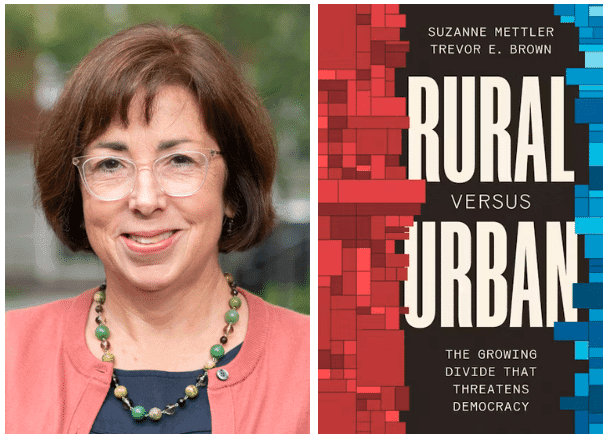
The story of how and why rural America became so lopsidedly Republican—and why the work of local organizers and elected Democratic Party officials is vital for restoring a rural civic landscape not dominated by single-party rule—is the subject of a recent book Rural Versus Urban: The Growing Divide That Threatens Democracy (Princeton University Press, 2025) by political scientists Suzanne Mettler and Trevor E. Brown.
The book combines five decades of analysis spanning thousands of counties, with on-the-ground interviews focused on counties in a few key states—Michigan, Ohio, North Carolina and Georgia. In short order, Mettler and Brown dispel the misperception that the rural-urban divide is grounded in policy positions, whether about government spending or social issues such as abortion and gun rights. While those differences matter, in Mettler and Brown’s view, partisan polarization doesn’t translate to ideological polarization. It’s more a matter of perceived identity, which has shifted dramatically since the late 1990s.
The consequences of this shift on American democracy are strikingly apparent to the 39 county Democratic and Republican chairs Mettler and Brown interviewed. The authors write, “Many Democratic county chairs told us about local supporters of the party who’ve become afraid to put political signs in their yard or sign a petition, for fear of losing friends, the services of repairmen or even their job.”
Mettler, a professor of American Institutions at Cornell University, talked with Barn Raiser about the historical developments that produced this divide, as well as counter-trends, such as the success of Howard Dean’s 50-state strategy, and more recent party-building efforts going on today that may hold the keys to reviving and saving American democracy.
Your book argues that rural-urban tensions aren’t new to American politics. Rather, the erosion of the New Deal political order, which focused on integrating rural America into a modernizing economy, resulted in the economic decline of rural America, and the political alienation that followed. And, if American democracy is to function as it should, we need to revive something analogous to New Deal programs to materially reintegrate rural America. Is that a fair reading of your argument?
I pretty much agree with it. One thing I would qualify slightly is when you say the rural/urban divide is “not new.” I would say if you go back through American history, you can find times where there were certainly social and cultural tensions between rural and urban places, and sometimes there were political divides, but they did not divide the whole country. This is the first time that rural places have lined up in one party and urban places in the other party. That’s unique and that’s what begins to emerge in the 1990s, but everything else you said I like.
How did the New Deal help farmers and rural communities survive the Great Depression and sustain a decent way of life for decades after?
Lots of different policies helped people. You had subsidies to help farmers with their crops, along with the Farm Security Administration. But there were also a lot of policies that helped all rural people. For example, the Tennessee Valley Authority and the Rural Electrification Administration brought electricity to rural places. This is really striking. Urban places had been acquiring electricity in the years before that, and rural places were really left behind. So these policies were quite dramatic. Places went from no electricity at all to suddenly the lights are lit. All kinds of things become possible through mechanization with electricity. That transforms people’s lives.
Even as late as 1980, your data shows rural and urban private employment grew equally fast, but things began to change in the Reagan era due to deregulation and the ending of antitrust enforcement. How did that hit rural communities?
In urban areas these things mattered as well, but urban areas were able to adapt more easily, and they were able to develop new aspects of their economy, whereas it just really gutted rural communities. You had all kinds of small businesses that went under with the rise of big-box stores. That ends up gutting all these little towns and villages sprinkled across the rural landscape. Other forms of deregulation were problematic for rural places, because you just don’t have the diversity of things going on in the economy that helps rural places. It’s also that they’re so far away. Airline deregulation was particularly harmful for rural places. We quote in the book Sen. Robert Byrd (D) who had voted for such deregulation, and later regrets it because of the impact it had. Here is what he said in 1986:
[T]his is one Senator who regrets that he voted for airline deregulation. It has penalized States like West Virginia, where many of the airlines pulled out quickly following deregulation and the prices zoomed into the stratosphere—doubled, tripled and, in some instances, quadrupled. So we have poorer air service and much more costly air service than we in West Virginia had prior to deregulation. I admit my error; I confess my unwisdom, and I am truly sorry for having voted for deregulation. I would welcome the opportunity to vote for reregulation because we people in the rural States are paying the bill.
That was followed in the 1990s by trade-driven losses in manufacturing with the North American Free Trade Agreement (NAFTA). This again hit rural communities hard and crippled union power. What impacts did it have materially on rural America, and politically how did it erode trust in the Democratic Party?
I would not have realized before we did the research how much rural places relied upon manufacturing. Deindustrialization began earlier in urban places, and sometimes plants moved to rural places, because it was cheaper to operate or there was less unionization, etc. But there were a lot of rural counties in the Midwest with strong unions in manufacturing. So this really goes under in the 1990s and early 2000, and it does as our trade policies become more open.
NAFTA was just a very visible instance of this. Rural people saw that Bill Clinton, a Democratic president, was signing this into law. While most Democrats in Congress voted against NAFTA, the fact that the president voted for it made it look like the Democrats were abandoning them. In so many places since the New Deal, rural people had seen the Democrats as the party that had their backs. And suddenly, it didn’t seem that way anymore.
It’s also the case there was a big fight over NAFTA, and the Democrats were divided. I had the opportunity to interview Rep. Richard Gephardt (who represented Missouri’s 3rd Congressional District) who had been really leading the opposition to NAFTA. Bill Clinton said, “Well I’ll send you to Mexico, work out a deal with them that will take care of our workers and the environment.” And Gephardt goes to Mexico, comes back with no deal. So he and David Bonior (House Majority Whip at the time representing Michigan’s 12th Congressional District) led the congressional opposition. And there were labor groups in the country that were all opposed to it and other kinds of organizations. But ultimately it gets enacted, and the Democratic president, Bill Clinton, signs it into law. So in other words, Democrats themselves helped make it very visible and then it really hurt the party.
As both party’s organizational structures weakened and unions were decimated, the GOP benefited from aligned movements. Your book highlights the growth of evangelical churches, the anti-abortion movement and the guns rights movement. Why are such organizations so important to this story and how did these intensify the geographic political divide?
Political parties at the organizational level have been getting weaker for decades because of the same kinds of reasons that civic organizations generally have—the kind of story that Robert Putnam tells in Bowling Alone (published in 2000). But parties can be helped by civic organizations that “connect the dots” for citizens—organizations that play a role in their everyday lives and convey to them which party is best representing their interests and values. Labor unions used to do this for the Democratic Party. But with deindustrialization, there’s many fewer strongly organized work places, so that’s not happening as much. And that has really hurt in a lot of rural areas, particularly in the Midwest.
Meanwhile the Republican Party has been helped by the growing involvement in politics of groups like evangelical churches and gun groups affiliated with the National Rifle Association. These are like your local rod and gun club and shooting ranges, where people have to go if they buy a gun, and they need to be licensed so they have to go through some training. Here they’re learning the NRA’s message about protecting the Second Amendment, and it’s the Republican Party that’s helping you with that. So these groups point the way for voters to the Republican Party. That’s helped that party out, and these groups are more prevalent on a per capita basis in rural areas than in urban areas. So they’ve made a real difference in cementing this divide.
We see this divide starting in the 1990s, due to these political economic changes, and then growing in the early 2000s, for reasons related to what we call “elite overreach,” and then becoming cemented by these organizational dynamics.
This concentration of power doesn’t necessarily benefit rural people, however. Why is that?
Rural places have not become better off since consolidating in support of the Republican Party. Prioritizing social issues like abortion—of which there just slightly more in rural places, on a per capita basis, than urban places—may be satisfying to some folks.] And yet there’s not transformative economic change that’s happening. So the Republican party does not seem to be helping out rural areas economically.
Rural people do benefit from redistributive policies.
Right. We looked carefully at all sorts of federals social welfare policies, and it turns out that rural counties rely upon them at least as much, and in many instances more than urban counties, as a percentage of income coming into the county.
There are more senior citizens per capita in rural places than urban and so, not surprisingly, there’s more Social Security and Medicare going to those places. Rural places depend heavily upon Medicaid, and SNAP (the Supplemental Nutrition Assistance Program) and so on. And yet, that does not seem to make rural people feel more warmly toward the Democrats, even though the Democrats really created most of these policies and have done the most to protect, sustain and expand them over time.
What rural people are looking for is a stronger economy and good jobs, health care and education, etc. Whether it’s for rural people or urban people, that’s what really bestows dignity on people.
Your book looks at how political power is distributed across rural America, favoring the power of the GOP, and how that is amplified through structures of the American constitutional system—the Electoral College, Congress, the courts. Could you hit a few of those highlights?
I appreciate you catching the argument we’re making that rural people themselves are not empowered by this. American political institutions have always given more political leverage to less populated places, and this is true through the Electoral College and the structure of the U.S. Senate, for example.
Every state, regardless of population, gets two senators. California has something like 66 times the population of Wyoming, but they both get two senators. So that gets repeated across all of these rural places, and that means that the U.S. Senate over-represents those states with less populations. In the past, this didn’t matter that much, because both parties had some strength in rural areas, so they checked each other. That advantage didn’t give rural areas, or less populated states generally, more political representation. But now it does, because for the first time in our history, rural areas across the nation have come together in the Republican Party. So one party gets all that benefit.
Republicans in the Senate these days tend to be from states that represent less than a majority of U.S. citizens. Political scientists have done a lot to document that less populated states in the U.S. Senate get more of the federal budget process, for example. This not only has an impact on policy making, it also means that the judiciary, which relies upon confirmation of judges by the Senate, is very much shaped by that. So, in other words, it leads to what you could call minoritarian power, where a minority of Americans have an outsized voice in in our political process.
Your book sees a way forward that lies in party-building, and in the key role county chairs play. Howard Dean’s 50-state strategy, which he implemented as chair of the Democratic National Committee from 2005-2009, provides a model of what’s possible. Dean started off as a county chair in Chittenden County, Vermont. What impact did the 50-state strategy have? And how are county chairs doing important work in the current environment?
One of the really fascinating parts of this book project was traveling around the country, particularly in four states, and interviewing county party chairs, both Republicans and Democrats. A lot of those counties have changed from voting for Democrats primarily in the 20th century to now voting for Republicans. We found that the Democratic Party chairs are really struggling, and not surprisingly, for all the reasons I mentioned and there’s been kind of a downward spiral for them. As the Republicans do better in elections, it becomes harder and harder for them to field candidates to create a slate of candidates. That goes all the way down the local races. And when that’s the case, local Democrats are less likely to come out and vote. They’ll say to the county chair, “Why should I bother to vote? We don’t even have a full slate of candidates.” And so you get a vicious cycle.
So it’s still the case that—even with this big divide in presidential elections—one out of three rural voters will vote for the Democratic candidate. But they need to be doing better in order to be competitive, and that capacity is there.
It was fascinating to interview county chairs in Georgia. This was not too long after Raphael Warnock and Jon Ossoff had won their statewide races for U.S. Senate. A lot of the rural county chairs felt that they had really helped those victories for the Democrats. They would say, “If we do nothing, the Democratic candidate hereby gets 34%, but we work our tails off, we can get them up to 37% of the vote in our county.” And they did that in county after county. And that extra margin of the vote helped get the Democrats across the finish line. That shows how, even though the Senate seems very formidable for Democrats to win, if they work hard on statewide races to just lose rural counties by less, they can win Senate seats. It becomes less of a heavy lift than transforming congressional districts.
So what happened with Howard Dean?
Generally speaking, this rural urban divide has been growing since the 1990s and yet there’s this interesting exception to the rule for a few years there. In 2005 Howard Dean becomes the head of the DNC. And his 50-state strategy is designed to work everywhere, to organize the party at the grassroots level. He’d been a county chair himself in Vermont, so he knew all about this. And he cared particularly about rural places. There were county chairs I interviewed in northern Michigan who still remembered when Howard Dean had gotten them all organized through the whole region of the lower Peninsula in northern Michigan and how effective that was.
Howard Dean is there doing that 2005-2006. You get to the midterms in 2006 and Democrats win back control Congress. This is during the second administration of George W. Bush. And then in 2008, Barack Obama wins the presidency and of course Obama himself did a lot of organizing in rural places. His Organizing for America (later, Organizing for Action) really built on top of what Howard Dean had already been establishing. Obama won in places that now Democrats say, “Oh we couldn’t possibly win there.” And that’s not all that long ago. So it shows the power of organizing. Sadly, that whole system came apart. And the DNC has not focused on organizing and Obama’s organization really became just like a mailing list of the DNC.
My co-author’s and my takeaway is that party building is needed. What’s needed is for the Democratic Party to have full-time, long-term organizers hired from rural places to organize in rural places. And they need to start out by listening, by asking rural people, “What your needs here? What would you like a political party to be doing for you? Why are local people upset with the Democratic Party? And what can we do to regain your trust?” And then to work hard over the long term to rebuild relationships. We think that is a very doable goal.
But it’s not going to happen if Democrats aren’t there on the ground. Right now, there are these county chairs, they are these valiant individuals, a lot of them are retired people. And some of them are really older, they’ll say, “You know I’m in my 70s. But I’m the younger member of the group that shows up for meetings. My officers are in their 90s.” And so they need help. Party building is really important.
In some places you have young people who’ve come into the Democratic Party, in other places the younger people are in other organizations that don’t align with the party. They may be working on climate change or gun safety, but they are doing are doing it as nonpartisan groups. Could you talk about the diversity of what you found?
This is true, generally, not only in rural places. A lot of Americans, and particularly younger Americans, are quite fed up with parties. They see parties as part of the problem, not part of the solution. What we as political scientists—speaking on behalf of the discipline generally—know is that political parties actually make democracy stronger. They present alternatives to voters and they help voters from one election to the next know which party is on their side generally, which party can represent them on the issues that they care about. And they do the organizational work of getting out the vote. So, for those reasons and many others, parties are important. But there’s been a real anti-party feeling because people associate them with the ardent polarization of our times.
Some of the county chairs told us there’s younger people here and they’re engaged politically but they don’t want to be part of the party. And I think that’s okay as long as groups will work in coalition with the party. But it would also really help for the parties to have more organizers who are younger people.
There were some counties that we visited, where you had a lot of recent retirees, and some people who were not retired, who joined together as a team to revitalize the party. Some of those were the counties where they seemed the most successful. Instead of there being just one leader, they had a bunch of people with different strengths and talents they were bringing to the table. And they had more fun because they’re working together.
Fun is a really overlooked important factor in politics to keep people engaged even when it’s hard over the long term.
Is there anything you would like to add?
Some of the most moving county chairs that I spoke with were people who would stress that this takes a lot of patience. It takes a lot of listening, and having conversations with people. That can really make a difference over the long haul—building relationships and listening. That shouldn’t be underestimated.
We tend to assume today that everyone’s mind is just made up, that nothing’s going to change. But that’s not true. Most people’s views on issues are more fluid. We just got into this terrible state of “us versus them” politics that does not have much to do with policy positions. It’s more about your team versus my team, and the geographic aspect of the rural-urban divide exacerbates that. If you feel like everyone you know is part of one party, then it’s easier to demonize those other people you don’t know who live in another place, who belong to another party. But in fact there are members of both parties everywhere.
People gravitate to one or the other everywhere. So rebuilding relationships and listening and conversations are really important.
In April 2025, In April, DNC Chair Ken Martin and Association of State Democratic Committees President Jane Kleeb announced their “Organize Everywhere, Win Anywhere” strategy. This new “50-State Strategy”(57 counting territories) promises to revive struggling state party infrastructure to help local Democrats compete, including shifting more resources from the DNC to state parties. Have you followed this development, or have you reconnected with any county chairs about it?
I have not been back in touch with county chairs in the past year. I am also curious about whether the DNC’s newly-promised funds are having an impact. It certainly sounds like a good strategy, but are the funds really helping out with organizing in rural areas? I’m very curious about this myself. Apologies that I don’t have an answer.
Finally, what’s the most important question I didn’t ask? And what’s the answer?
One thing we didn’t talk about and that was the elite overreach dynamic. You have the pulling apart in the 1990s of place-based inequality. But then in the subsequent period, rural people start to think of Democrats as these people who live far away in cities and urban metropolitan areas, and who are better off than themselves, and who seem to like to tell them what to do. On policy after policy, rural people often support the basic idea of the policy on its merits, but they don’t like the way it’s implemented, because they feel that it controls their lives and their communities in ways they don’t like. They feel that they were not consulted in the process, and the people who created the policy didn’t have an understanding of their communities and what would work well there.
This grows with the educational divide between rural and urban places. It used to be that highly educated people in the United States were more likely to be Republicans, but by the 1990s, they become more likely to be Democrats. Then in the early 2000s, in rural places where most people have not gotten college degrees, they change from being more likely to be Democrats to more likely to be Republicans. And we see that as being in reaction to what’s happened already to the Democratic Party in urban places.
An illustration of a policy area where people feel like they’re being told what to do, is in the siting of wind and solar installations.
Interesting studies from all over the country told a similar story, where rural communities feel that what happens is that the developer comes in and they cut a deal with a big landowner in the area and they get all sorts of waivers from standard public policies to do this. And then only after it’s all settled does the local community learn about it. And they feel that they got sidelined. They feel that they didn’t have a voice and they would’ve liked some aspects of it to have happened on terms they set or that they agreed to.
This is happening in so many places. Somebody in Indiana in one of the studies said, “It’s not that I’m against wind power. I’m against how it was done here.” It’s very hard for urbanites to understand. Urbanites can sit back and say oh that’s all NIMBYism, but urbanites are the ones who can benefit from all of that wind and solar, and to rural people it seems really extractive, the way it’s done. But we need this for the future, for the future of the planet. So we have to get past this rural-urban divide and we have to listen to each other.